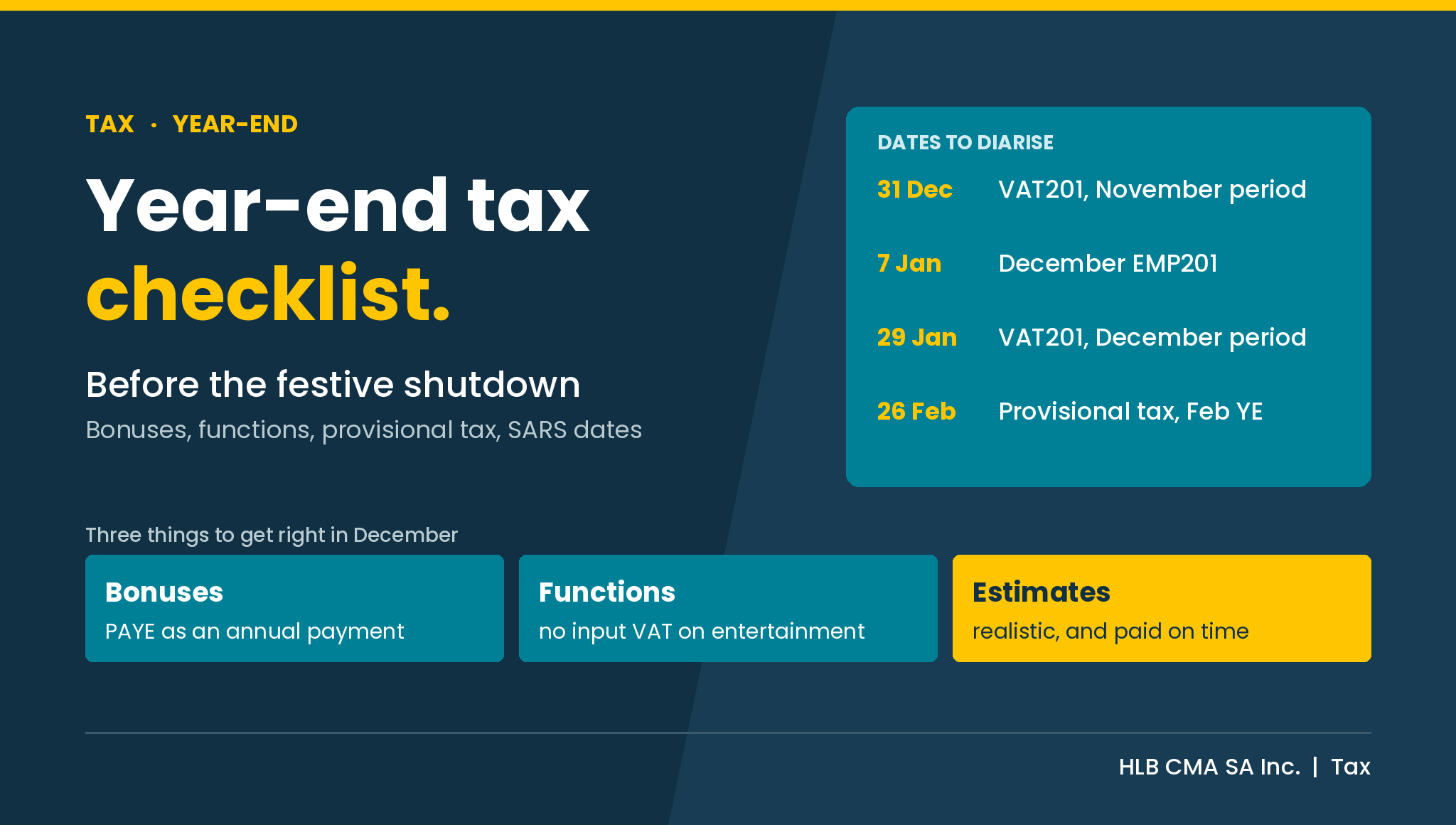
December is when small tax errors are easiest to make. Bonuses go through the payroll, the year-end function is booked, people go on leave and SARS deadlines fall between public holidays. Errors made now usually surface later, as an IRP5 correction, a VAT adjustment or a provisional tax penalty. This checklist covers the four areas we see most often at this time of year.
1. Year-end bonuses: PAYE, UIF and SDL
A bonus is remuneration, so employees’ tax must be withheld when it is paid. SARS treats a bonus as an annual payment, and its guide for employers sets out how to calculate the tax:
- work out the tax on the employee’s annual equivalent of normal remuneration, without the bonus;
- work out the tax on that annual equivalent plus the full bonus (the bonus itself is not annualised);
- the difference between the two is the PAYE on the bonus, deducted in the month it is paid.
A bonus is taxed at the employee’s marginal rate, so the deduction is often higher than people expect. A short note to staff before payday avoids a lot of questions.
Before the December payroll is finalised:
- make sure bonuses are set up as annual payments in your payroll system, so they are reported under source code 3605 on the IRP5;
- remember that a bonus is remuneration for UIF and SDL too, although UIF contributions remain subject to the monthly earnings ceiling;
- include the bonuses in the December EMP201, which is due by Thursday, 7 January 2027.
Getting the codes right now saves corrections when the annual EMP501 reconciliation is prepared after the tax year ends on 28 February.
2. Year-end functions, staff lunches and hampers: VAT and fringe benefits
Section 17(2)(a) of the VAT Act generally denies input tax on entertainment. Entertainment is defined widely: food, beverages, accommodation, entertainment, amusement, recreation or hospitality of any kind, provided to anyone in connection with your business. That covers most year-end functions, staff and client lunches, and gift hampers that contain food or drink.
The exceptions are narrow. They include entertainment you supply in the ordinary course of an entertainment business, costs you recover in full from employees, and meals and accommodation for employees who have to spend a night away from home and from their usual place of work. In Aveng Mining Shafts & Underground v CSARS (2025), the Supreme Court of Appeal confirmed that these exceptions are read strictly and disallowed more than R17 million of input tax claimed on meals and accommodation at remote mining sites.
In practice:
- code entertainment costs to a separate account in the ledger;
- make sure no input tax on those costs is claimed in the VAT201;
- keep the invoices: the cost is usually still deductible for income tax, even though the VAT cannot be claimed.
For employees, a year-end function is usually not a taxable fringe benefit. Paragraph 8 of the Seventh Schedule to the Income Tax Act places no value on meals and refreshments provided on a special occasion or during working hours. Cash gifts and vouchers are a different matter and should go through the payroll.
3. Provisional tax: the second payment
For companies with a February year-end, the second provisional tax payment for the 2027 year of assessment is due on Friday, 26 February 2027, because 28 February falls on a Sunday. Companies with a December year-end make their second payment for the 2026 year by Thursday, 31 December 2026, and companies with a June year-end make their first payment for the 2027 year on the same day.
The second payment must be based on a realistic estimate of taxable income for the whole year. Two penalties apply:
- late payment: 10% of the amount not paid on time, plus interest;
- underestimation: 20% of the shortfall in tax where the estimate is too low. Where taxable income is more than R1 million, the estimate must be at least 80% of the actual taxable income. At or below R1 million, the penalty applies only if the estimate is below 90% of actual taxable income and also below the basic amount (broadly, taxable income in the latest assessment).
A Tax Administration Laws Amendment Bill now before Parliament proposes two changes: raising the R1 million threshold to R1.8 million for years of assessment starting on or after 1 March 2026, and, where the second payment is not paid in full within a month of the due date, treating the estimate as equal to the amount actually paid, which could trigger the underestimation penalty even if the estimate itself was correct. These are proposals until the Bill is enacted, but the practical message is the same: estimate realistically and pay the full amount by the due date.
For February year-ends, management accounts to the end of November give a sound base for the estimate. A voluntary third payment, made within seven months after year-end, can still limit interest if the final figure turns out higher.
4. SARS dates over the festive season
- Monday, 7 December 2026: EMP201 for November.
- Wednesday, 16 December 2026: Day of Reconciliation (public holiday).
- Friday, 25 December 2026 and Friday, 1 January 2027: public holidays.
- Thursday, 31 December 2026: VAT201 for periods ending in November, filed and paid on eFiling; second provisional payment for December year-ends; first provisional payment for June year-ends.
- Thursday, 7 January 2027: EMP201 for December, including PAYE on bonuses.
- Friday, 29 January 2027: VAT201 for periods ending in December, filed and paid on eFiling.
- Friday, 26 February 2027: second provisional payment for February year-ends.
5. Before you close the office
- Agree the date of the last payment run with suppliers and your bank.
- Confirm who will authorise payments while people are on leave, and keep two-person approval in place.
- Make sure someone checks SARS eFiling correspondence during the break, so that a verification request or audit letter does not sit unanswered.
- Verify any change of supplier or employee bank details by phone. Our article on payment diversion fraud explains why this matters most in December.
How we can help
Our tax team can review your December payroll treatment, check your VAT coding before year-end and prepare your provisional tax estimate with you. If your company has a February year-end and reports under IFRS for SMEs, see also our article on the third edition and February year-ends.
Speak to our team before the festive shutdown.
This article provides general information only and is not tax advice. It refers to SARS’s Guide for Employers in respect of Employees’ Tax (2027 tax year), section 17(2)(a) of the Value-Added Tax Act, paragraph 8 of the Seventh Schedule and paragraphs 20 and 27 of the Fourth Schedule to the Income Tax Act, the Supreme Court of Appeal judgment in Aveng Mining Shafts & Underground v CSARS (2025), and the Tax Administration Laws Amendment Bill, 2026, as at November 2026. Speak to a tax adviser about your specific circumstances.
paye,provisional-tax,sars-deadlines,vat,year-end-tax,