If your company reports under the IFRS for SMEs Accounting Standard and has a February year-end, the changes in the third edition already affect the year you are in now.
The International Accounting Standards Board (IASB) published the third edition in February 2025. It applies to annual reporting periods beginning on or after 1 January 2027, and earlier application is permitted. Read the IFRS Foundation’s overview.
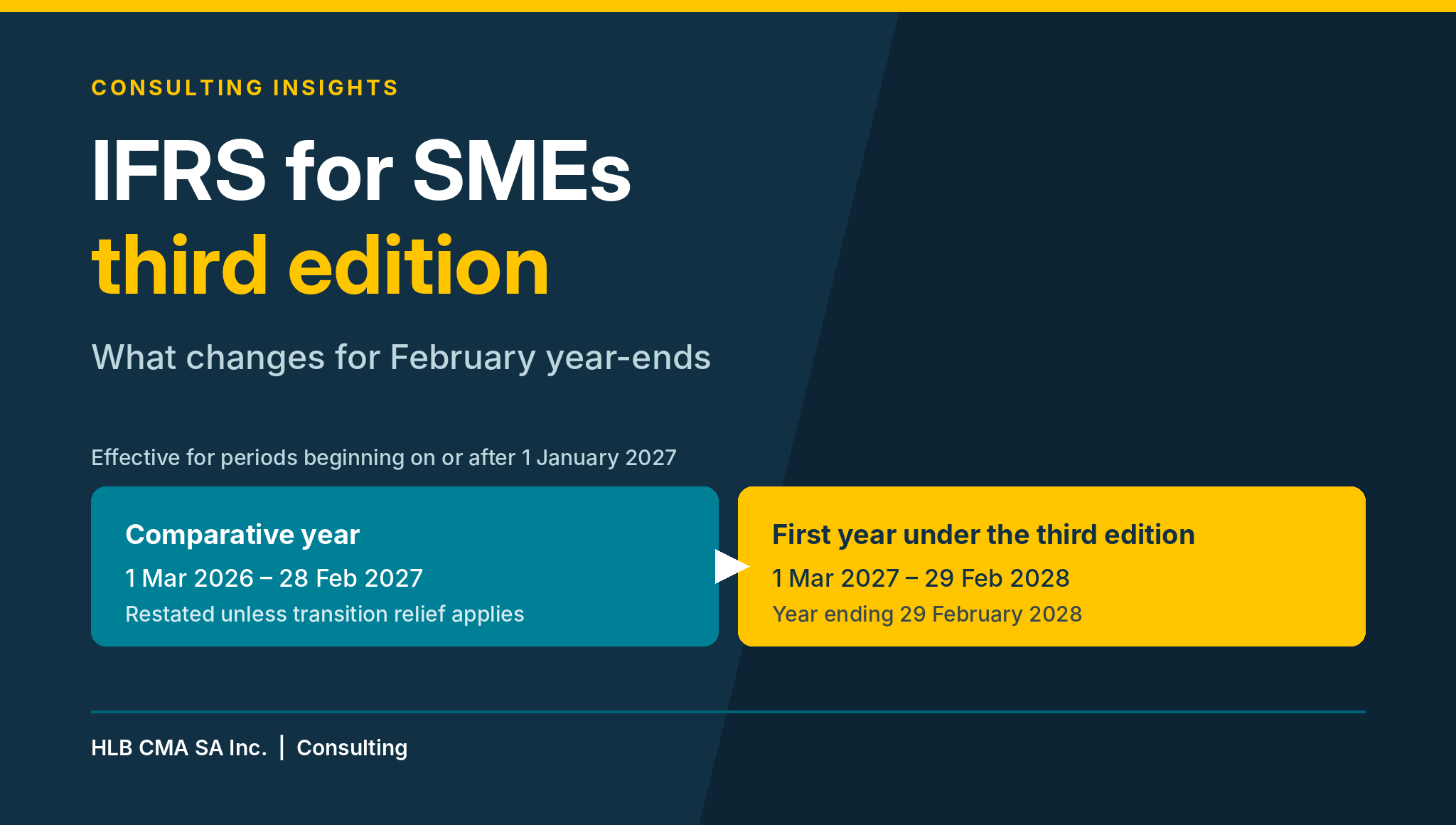
For a February year-end, the first financial year under the third edition is the year ending 29 February 2028. The revised sections are applied retrospectively, so unless a transition relief applies, the comparative figures for the year ending 28 February 2027 must also reflect the new requirements. That comparative year started on 1 March 2026.
What changes
Revenue (Section 23). The revenue section has been rewritten to align with IFRS 15, using a simplified version of its five-step model: identify the contract, identify the performance obligations, determine the transaction price, allocate it to the performance obligations, and recognise revenue when or as each obligation is satisfied. Companies with bundled sales, long-term projects or variable consideration are the most likely to see differences in the timing of revenue.
Financial instruments (Section 11). The former Sections 11 and 12 are combined into a single section that reflects IFRS 9 with simplifications. The option to apply IAS 39 falls away, and debt instruments are classified based on their contractual cash flow characteristics. The IASB decided not to introduce an expected credit loss model. New disclosures include an ageing analysis of financial assets and a maturity analysis of financial liabilities, and there are new requirements for certain financial guarantee contracts. KPMG’s summary of the changes.
Fair value measurement (new Section 12). Fair value requirements that were previously spread across the standard are brought together in a new section based on IFRS 13, with related disclosures.
Consolidation and business combinations (Sections 9 and 19). Control is assessed using a single model aligned with IFRS 10. Business combinations follow the acquisition method, and contingent consideration is measured at fair value, both at acquisition and afterwards.
Statement of cash flows (Section 7). New disclosures cover supplier finance arrangements and a reconciliation of changes in liabilities arising from financing activities. Forvis Mazars’ overview.
Concepts and pervasive principles (Section 2). This section has been revised to align with the IASB’s 2018 Conceptual Framework.
What does not change
Leases are unchanged. Section 20 has not been aligned with IFRS 16, so lessees continue to account for operating leases as an expense rather than recognising a right-of-use asset. The IASB intends to reconsider this at its next comprehensive review of the standard.
Transition: retrospective, with some relief
The revised sections are applied retrospectively. The IASB provides transition relief for Sections 9, 12, 19 and 23. For revenue, for example, companies may continue to apply their existing revenue policy to contracts already in progress. Which reliefs are worth using depends on your contracts, group structure and acquisition history, so it pays to decide early rather than at year-end.
Your February year-end checklist
☐ Confirm your framework. Check that the company reports under IFRS for SMEs and remains eligible. The definition of public accountability now expressly covers entities such as banks, insurers and securities brokers.
☐ Review your revenue contracts. List your main contract types and identify performance obligations, variable consideration and long-term contracts.
☐ Classify your financial instruments. List loans, receivables, investments and financial guarantees, including intercompany guarantees, and assess them under the revised Section 11.
☐ Start collecting data for the new disclosures now. Ageing of financial assets, maturity of financial liabilities, movements in financing liabilities and supplier finance arrangements will be needed for the comparative year as well.
☐ Reassess group structures. Groups should review control under the single model and the accounting for any acquisitions.
☐ Decide on transition reliefs. Document the choices made and the opening position at 1 March 2026.
☐ Update your financial statement template. Revise accounting policies, notes and disclosures, and discuss the approach with your auditor or independent reviewer early.
How our Consulting department can help
Our Consulting department assesses how the third edition affects your accounting policies, disclosures and comparatives, and updates your financial statement format before your first reporting period under the revised standard. Compilation engagements are performed by our Consulting department, which is separate from our audit and assurance teams.
Explore our Consulting services or email our Consulting team.
This article provides general information only and is not a substitute for advice on your company’s specific circumstances.
annual-financial-statements,consulting,february-year-end,financial-instruments,financial-reporting,ifrs-for-smes,ifrs-for-smes-third-edition,revenue-recognition,