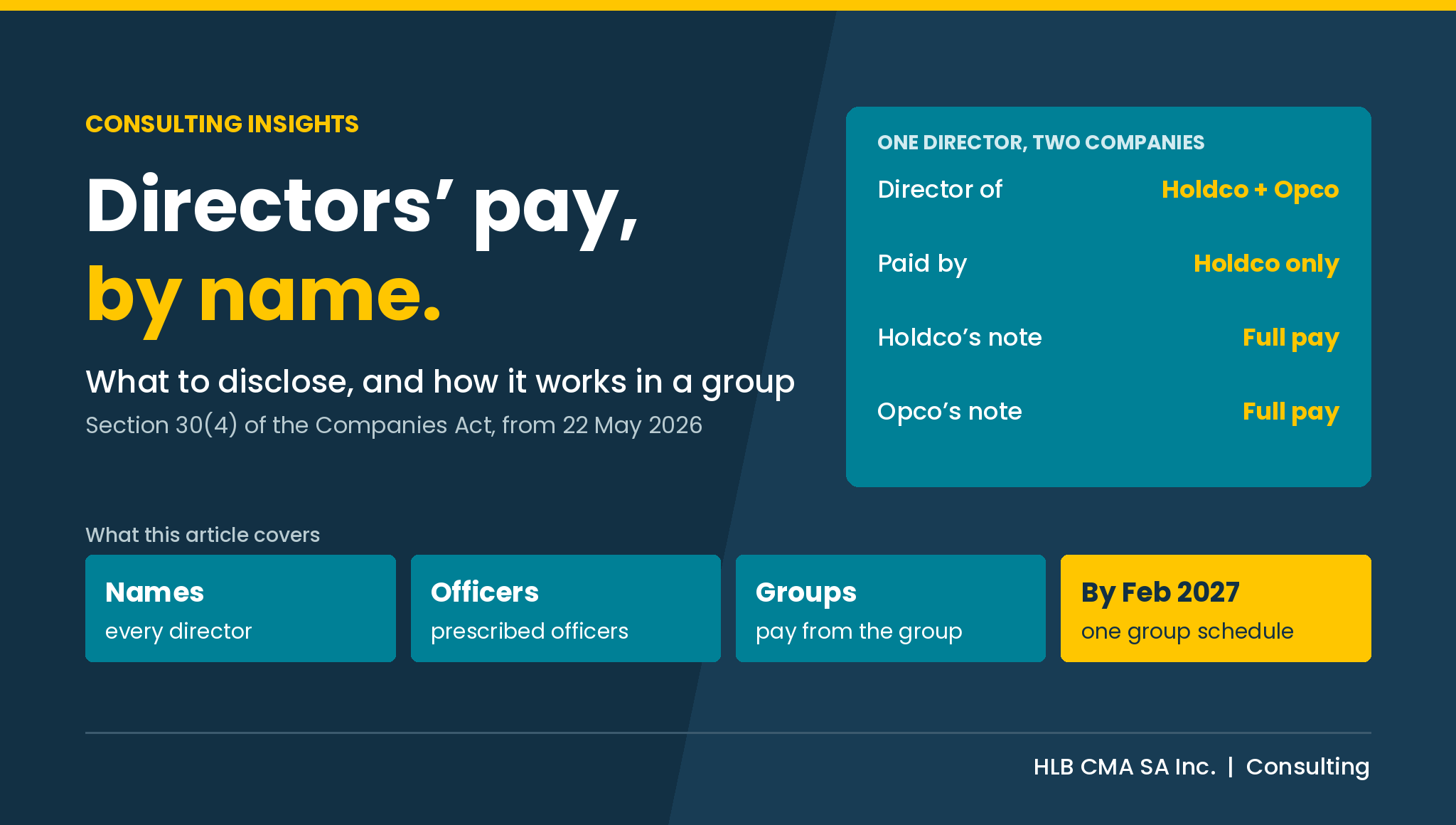
If you sit on the boards of two companies in the same group and only one of them pays you, what do the other company’s annual financial statements say about you? A note that only says the directors are paid by the holding company is not unusual. Where the holding company is South African, it does not meet the Companies Act. Since 22 May 2026 the question matters more, because the answer must now carry your name.
The Companies Amendment Act 16 of 2024 substituted section 30(4)(a) of the Companies Act. From 22 May 2026, the annual financial statements of every company that must be audited, private companies included, must show the remuneration and benefits received by “each individual director and prescribed officer in the company, both of whom must be named”. This article explains which companies are caught, who must be named and what to disclose. It then works through the group rules with an example.
What changed, and what didn’t
Section 30(4) has always required particulars of the remuneration and benefits received by each director and prescribed officer of a company that must be audited. SAICA’s guidance has long been that this means disclosure per person, by name, rather than a single total, and in its Notice 38 of 2020 CIPC said that disclosing one aggregated amount is incorrect. Even so, totals and labels such as “Director A” still appear. The amendment puts names in the Act itself, so that argument is over.
The amending Act has no transitional provision. The new wording has applied since 22 May 2026, whatever a company’s year-end, so financial statements approved after that date should already comply. For February year-ends, the work for the year ending 28 February 2027 starts now.
Public and state-owned companies also have new rules on a remuneration policy and a remuneration report (sections 30A and 30B). This article deals with the note in the financial statements, which every company that must be audited has to include.
Which companies must make the disclosure
Section 30(4) applies to every company that the Companies Act requires to be audited. Under section 30 and regulation 28 of the Companies Regulations, that means:
- public companies and state-owned companies;
- companies with a public interest score of 350 or more for the year;
- companies with a public interest score of at least 100 whose financial statements for the year were compiled internally;
- companies that, in the ordinary course of their primary activities, hold assets in a fiduciary capacity for persons not related to them, where those assets exceed R5 million at any time during the year;
- certain non-profit companies, such as those incorporated directly or indirectly by the state, or primarily to perform a statutory, regulatory or public function.
Two groups of companies need care:
- Companies audited voluntarily. If your company is audited only because its MOI, its shareholders or its board require it, CIPC’s view (Notice 38 of 2020) is that the disclosure applies anyway, and that failing to make it is a contravention of the Act that CIPC may investigate. SAICA disagrees and reads the requirement as limited to companies the Act requires to be audited. Until this is settled, the safer course is to disclose.
- Companies that are independently reviewed. Section 30(4) does not apply to them. If they report under the IFRS for SMEs Accounting Standard, they must still disclose the total compensation of key management personnel, which we come to below.
If a director received nothing, the note should say so: CIPC expects a note even where no remuneration was paid. Non-profit companies whose directors serve without pay are a common example.
Who must be named
- Every director who held office during the year, including those who were appointed or resigned during it. SAICA’s view is that the disclosure covers anyone in office at any time during the year, for the period they held office.
- Every prescribed officer. Under regulation 38, a person who is not a director is a prescribed officer if they exercise general executive control over and management of the whole, or a significant portion, of the business and activities of the company, or regularly participate to a material degree in that control and management. Titles don’t matter. A chief operating officer who isn’t on the board, a general manager who runs a large division or a financial manager who regularly takes part, to a material degree, in running the business may all qualify. Ask the board to assess each senior manager against the test and minute its conclusion.
- Past directors and prescribed officers who receive a pension from the company or compensation for loss of office.
What to disclose for each person
Section 30(6) says that remuneration includes:
- fees for services as a director, including any amount paid to a person for accepting the office of director;
- salary, bonuses and performance-related payments;
- expense allowances, to the extent that the director is not required to account for them;
- pension contributions that are not disclosed separately;
- the value of any option or right given to the person, or to a person related to them (section 42);
- financial assistance to the person, or a related person, to subscribe for or buy securities (section 44);
- for a loan or other financial assistance by the company to the person or a related person, or a loan by a third party that the company guarantees (section 45), any interest deferred, waived or forgiven, or the difference between a fair market rate and the interest actually charged.
The last item is easy to miss in family-owned companies. An interest-free loan from the company to a director, or to a company or trust they control, has a remuneration value that must be calculated and disclosed.
Section 30(4) also asks for:
- pensions paid by the company to current or past directors and prescribed officers, and amounts the company paid or must pay to a pension scheme for them;
- compensation for loss of office;
- the number and class of any securities issued to a director, a prescribed officer or a person related to them, and the consideration the company received;
- details of the service contracts of current directors and prescribed officers.
Benefits include items such as medical aid contributions, a company car or accommodation, so include their value. The Act refers to amounts paid or receivable, so include a bonus earned in the year but paid after year-end. The comparative figures must be by name as well. SAICA recommends putting the disclosure in the notes. If it goes in the directors’ report instead, it is still audited.
The group question: a director paid by another company in the group
Section 30(5) is the part that matters for groups. It says the disclosure must show the amount of any remuneration or benefits paid to or receivable by persons in respect of:
(a) services rendered as directors or prescribed officers of the company; or
(b) services rendered while being directors or prescribed officers of the company—
(i) as directors or prescribed officers of any other company within the same group of companies; or
(ii) otherwise in connection with the carrying on of the affairs of the company or any other company within the same group of companies.
Three things follow from this wording:
- The disclosure follows the directorship, not the payroll. If you are a director of a company, its note shows what you received from any company in the group while you were its director, even if that company paid you nothing. As SAICA puts it, “the source of payment does not determine the disclosure”.
- A company that pays someone who is not its director or prescribed officer does not disclose them. The pay appears in the notes of the companies where that person holds office.
- The same total can appear in more than one company’s note. This is not double counting: each note answers the question for that company’s own directors and prescribed officers.
A “group of companies” is a holding company and all of its subsidiaries (section 1), so it runs up, down and sideways: the holding company, its subsidiaries and fellow subsidiaries. Associates and joint ventures are not part of it. For pay from other group companies, only the period in which the person was a director or prescribed officer of the company counts.
A worked example
Holdco (Pty) Ltd owns all the shares in Opco (Pty) Ltd. Both companies must be audited. Their financial year ends on 28 February 2027. The names and figures are illustrative.
- Lerato Dlamini is a director of both companies. Holdco employs and pays her as group chief executive: a salary of R1 800 000, a bonus of R300 000 for the year (paid in May 2027) and retirement fund contributions of R162 000. Opco pays her nothing.
- Anna Pillay is a non-executive director of Holdco for the whole year, with fees of R180 000. She joins Opco’s board on 1 September 2026 and receives no extra fee.
- Sipho Mokoena is a director of Opco only. Opco employs and pays him as managing director: a salary of R1 100 000, a bonus of R150 000 and retirement fund contributions of R100 000.
This is what each company’s financial statements show:
| Person |
Holdco’s financial statements |
Opco’s financial statements |
Lerato Dlamini
director of both, paid by Holdco |
R2 262 000, for her services to Holdco |
R2 262 000, received from Holdco while she was a director of Opco |
Anna Pillay
director of Holdco, and of Opco from 1 September 2026 |
R180 000, her fees as a director of Holdco |
R90 000, her Holdco fees for 1 September 2026 to 28 February 2027, while she was also a director of Opco |
Sipho Mokoena
director of Opco only, paid by Opco |
Not disclosed: he is not a director or prescribed officer of Holdco |
R1 350 000, for his services to Opco |
Opco’s note for the year ended 28 February 2027 could look like this (amounts in rand):
| Name |
Fees |
Salary |
Bonus |
Retirement fund contributions |
Total |
| Lerato Dlamini* |
– |
1 800 000 |
300 000 |
162 000 |
2 262 000 |
| Anna Pillay* |
90 000 |
– |
– |
– |
90 000 |
| Sipho Mokoena |
– |
1 100 000 |
150 000 |
100 000 |
1 350 000 |
| Total |
90 000 |
2 900 000 |
450 000 |
262 000 |
3 702 000 |
* Paid by Holdco (Pty) Ltd, another company in the group, for services rendered while a director of the company. Anna Pillay was appointed a director of the company on 1 September 2026.
Opco’s statement of profit or loss carries no cost for Lerato or Anna, yet its note shows R2 352 000 for them. That is expected: SAICA points out that the expense in a company’s profit or loss will not always agree with the amounts disclosed under section 30(4). A footnote saying who paid makes the note easy to follow.
The short answer for a director of two companies in a group who is paid by only one of them
If both companies must be audited, both notes show all your pay and benefits from the South African companies in the group, by name, for the time you were a director of that company. The company that pays you shows it as pay for your services to it. The other shows the same amount as pay received from another group company. Neither can show nil, or simply say that you are paid by the holding company. If only one of the two must be audited, only that one makes the disclosure, but it still includes what the other company paid you.
Prescribed officers employed elsewhere in the group
A person employed and paid by Holdco who runs Opco’s business may be Opco’s prescribed officer even though they are not on Opco’s board. If so, Opco names them and discloses their pay from Holdco.
Foreign holding companies and trusts
Under the Act, a foreign company or a trust can be a holding company, so its South African subsidiaries still form a group, and fellow subsidiaries disclose what the other paid a director they share. But a foreign company or a trust is not a “company” as the Act defines it. SAICA’s view is that amounts paid for services to them, such as fees as a director of the foreign parent, are not disclosed in the South African companies’ notes.
In our view, amounts that a foreign parent pays someone specifically for being a director of the South African company are different. Section 30(5)(a) looks at the services, not at who pays, so they are disclosed. Where one salary from the parent covers both roles, the Act does not say how to split it. Agree a reasonable basis with your auditor and document it.
Management fees
Many groups recover the cost of their directors from subsidiaries through a management fee. The fee does not change the Companies Act note, which shows what each person received. Under the third edition of the IFRS for SMEs Accounting Standard, a company that obtains key management personnel services from a separate management entity discloses the amounts it incurred for those services, rather than the compensation that the management entity pays its own employees or directors (paragraph 33.7A).
The related party note answers a different question
The IFRS for SMEs Accounting Standard requires every company that applies it, whether audited or independently reviewed, to disclose the compensation of its key management personnel in total (paragraph 33.7). Key management personnel include every director. Compensation includes amounts paid on the company’s behalf, for example by its parent, in exchange for services rendered to the company (paragraph 33.6). Companies that report under full IFRS apply IAS 24, which asks for the total and a split by category.
So the related party note shows compensation for services to the company itself, as one total. The Companies Act note shows each person’s pay, by name, from the company and the rest of the South African group while they held office. In a group the two will often differ. That is acceptable, but each note should say what it includes.
For February year-ends, the third edition, including paragraph 33.7A, first applies to the year ending 29 February 2028, unless a company adopts it early. Our article on what the third edition changes for February year-ends covers the transition.
What to gather before 28 February 2027
- A register of everyone who was a director or prescribed officer of each South African company in the group during this year and last year, with appointment and resignation dates.
- The board’s assessment of who the prescribed officers are, applying regulation 38, with the reasons minuted.
- A group remuneration schedule: for each person, every amount received from every South African company in the group, by month, so it can be cut to the period they held office in each company. Include fees, salary, bonuses earned but unpaid at year-end, allowances, retirement fund and medical aid contributions, other benefits and share options.
- Loans to directors, prescribed officers and related persons: the balances, the interest charged and a fair market rate.
- Pensions paid to past directors and prescribed officers, and any compensation for loss of office.
- Securities issued to directors, prescribed officers or related persons, with the consideration received.
- The key terms of current service contracts, such as their duration and notice periods.
- The same per-person figures for the comparative year.
- A word with each director and prescribed officer. Their names and pay will appear in financial statements that go to shareholders and, for most audited companies, are filed with CIPC with the annual return.
Build the group schedule once and produce every company’s note from it. The figures then agree across the group, including the comparatives.
How our Consulting department can help
Our Consulting department prepares annual financial statements for companies and groups. For directors’ remuneration, it can:
- set up a group schedule of directors’ and prescribed officers’ pay that feeds each company’s note;
- take your board through the prescribed officer test;
- draft remuneration and related party notes that meet section 30 of the Companies Act and Section 33 of the IFRS for SMEs Accounting Standard.
If we are your auditor, speak to your engagement team before year-end about who your prescribed officers are and how the note will be presented. Compilation engagements are performed by our Consulting department, which is separate from our audit and assurance teams. Our article on the February year-end close covers the rest of the year-end preparation.
Explore our Consulting services or email our Consulting team.
This article provides general information only and is not legal advice or a substitute for advice on your company’s specific circumstances. It refers to sections 1 and 30 of the Companies Act 71 of 2008 as amended by the Companies Amendment Act 16 of 2024 (section 30(4)(a) in force from 22 May 2026), regulations 28 and 38 of the Companies Regulations, 2011, CIPC Notice 38 of 2020, SAICA’s FAQs on the disclosure of directors’ remuneration (updated March 2022), Section 33 of the IFRS for SMEs Accounting Standard and IAS 24, as at November 2026.
annual-financial-statements,companies-act,consulting,directors-remuneration,group-companies,ifrs-for-smes,prescribed-officers,section-304,