For companies with a February year-end, the year-end close has already started. The financial year ends on Sunday, 28 February 2027, and most audit and review adjustments come from areas that are far easier to fix in November than in March: debtors, the fixed asset register and the stock count. This year there is a fourth: the comparative information for the IFRS for SMEs third edition. This article sets out what to start now, and why regulators keep finding problems in the same places.
Where regulators keep finding problems
Inspection and enforcement findings are about audits, not about the companies that were audited. But audit evidence comes from your records, and the same areas come up year after year:
- Judgement areas. The IRBA’s 2025 Public Inspections Report, published in March 2026, found recurring problems with accounting estimates, going concern, revenue recognition, journal entries and disclosures. Only 28% of the audit engagements inspected met the required standard. The IRBA cautions that it selects audits for inspection on risk, so the results do not describe the average audit.
- Evidence and documentation. In the IRBA’s enforcement report for 2023/2024, 51% of the 191 charges on which auditors were found guilty concerned insufficient audit evidence or inadequate documentation. The report lists inventory, cost of sales and depreciation among material misstatements that were often overlooked. It also describes a case in which replaced parts that had not been derecognised still had a book value on the fixed asset register.
- Estimates and inventory, internationally. In the 2025 survey of inspection findings by the International Forum of Independent Audit Regulators, published in April 2026, accounting estimates had the highest rate of findings in inspected audits of listed companies. The most common finding in that area was that the auditor had not assessed whether management’s assumptions were reasonable. Findings on inventory procedures rose from 20 to 29.
Every estimate on that list, from a doubtful debt allowance to a useful life or a stock write-down, starts with management’s own assessment. If that assessment is made and documented before year-end, the audit or independent review goes faster and with fewer surprises.
1. Debtors: clean up the ledger before the festive shutdown
Trade receivables are one of the first areas an auditor or independent reviewer looks at, and one of the hardest to fix after year-end, when customers are harder to reach.
- Reconcile the debtors ledger to the general ledger every month, not only at year-end.
- Allocate unallocated receipts and clear old credit balances, duplicate accounts and amounts posted to the wrong customer.
- Pass credit notes for disputes and errors that have already been agreed.
- Follow up overdue accounts in early December, before customers close for the holidays.
- Check cut-off: goods delivered in February should be invoiced in February.
- If your auditor plans to confirm balances directly with customers, give them up-to-date contact details early.
Impairment. Under the IFRS for SMEs Accounting Standard, impairment of trade receivables is still based on objective evidence: the third edition did not introduce an expected credit loss model. At each reporting date, assess whether there is objective evidence that a receivable is impaired, such as significant financial difficulty of the customer, a default or late payment, or a probable liquidation (paragraphs 11.21 and 11.22). Individually significant balances must be assessed individually (paragraph 11.24). For each large overdue balance, record why it is, or is not, recoverable: payment arrangements, correspondence and any security held. Companies that report under full IFRS apply the expected credit loss model in IFRS 9 instead.
Tax. For companies that do not apply IFRS 9, the section 11(j) doubtful debt allowance depends on how long debts have been in arrears, with thresholds at 60 and 120 days. An accurate age analysis therefore supports the tax computation as well as the financial statements.
2. Fixed asset register: make sure it matches what you own
Property, plant and equipment is often the largest number on the balance sheet, and the register drifts quietly: assets are sold, scrapped or replaced, and nobody tells finance.
- Reconcile the register to the general ledger, including this year’s additions and disposals.
- Physically verify the larger items, and tag them if you have not.
- Remove assets that have been sold, scrapped or stolen, and record the profit or loss on disposal.
- When part of an asset is replaced, such as an engine or a roof, capitalise the new part and derecognise the carrying amount of the old one (paragraph 17.6). This was the issue in the enforcement case above.
- Keep the invoices for this year’s additions, and check that repairs and maintenance have not been capitalised.
Useful lives and residual values. A change in how an asset is used, significant unexpected wear and tear, technological advancement or changes in market prices may mean that its useful life or residual value has changed. Where there are such indicators, review the estimates and account for any change as a change in accounting estimate (paragraph 17.19). Fully depreciated assets that are still in daily use are a common sign that useful lives were set too short. The third edition clarifies that an expected fall in the selling price of what an asset produces can point to obsolescence (paragraph 17.21(c)), and that a depreciation method based on revenue is not appropriate (paragraph 17.22).
Impairment. At each reporting date, consider whether any asset is impaired (paragraph 17.24 and Section 27). Idle or damaged equipment, assets you plan to sell and loss-making parts of the business are the usual places to look.
Our article on fully depreciated assets that are still in use covers useful lives, the wear-and-tear allowance, deferred tax and leases in more detail.
3. Stock count: plan it now
28 February 2027 falls on a Sunday, so decide now when the count will take place. If it will not be on the year-end date, plan how movements between the count and the year-end will be recorded and checked.
- Agree the date with your auditor early. Where inventory is material, International Standard on Auditing 501 requires the auditor to attend the physical count unless that is impracticable, so the date has to work for both of you.
- Write count instructions: who counts, who checks, how counts are recorded and how differences are investigated.
- Record cut-off: note the last delivery note and goods received note numbers before the count, and stop stock movements during it.
- Identify slow-moving, damaged and obsolete stock during the count, not afterwards.
- Keep goods held for customers or on consignment separate, and confirm stock held by third parties.
Measurement. Inventories are measured at the lower of cost and estimated selling price less costs to complete and sell (paragraph 13.4), using the first-in, first-out or weighted average cost formula. LIFO is not permitted (paragraph 13.18). At the end of each reporting period, assess whether any inventories are impaired (paragraph 13.19). Use the count list of slow-moving and damaged items, together with recent selling prices, to support any write-down instead of a round-number provision.
4. IFRS for SMEs third edition: the year you are closing is the comparative year
The third edition applies to annual periods beginning on or after 1 January 2027. For a February year-end, the first year under the new standard ends on 29 February 2028, and its comparative year is the year ending 28 February 2027: the year you are closing now. The revised sections are applied retrospectively unless a transition relief applies, and information that is not captured at 28 February 2027 can be hard to rebuild later.
Capture this information at 28 February 2027:
- an ageing of trade receivables and other financial assets by due date, showing the gross amount and any impairment separately (paragraph 11.43);
- a maturity analysis of financial liabilities, based on the remaining contractual, undiscounted cash flows (paragraph 11.43A);
- movements in liabilities arising from financing activities, such as loans and finance lease liabilities;
- any supplier finance arrangements;
- a list of your main types of contract with customers, for the revised revenue section (Section 23).
The debtors clean-up in step 1 gives you most of the first item. Our article on what the third edition changes for February year-ends covers the changes and the transition reliefs in more detail.
A timetable from now to 28 February
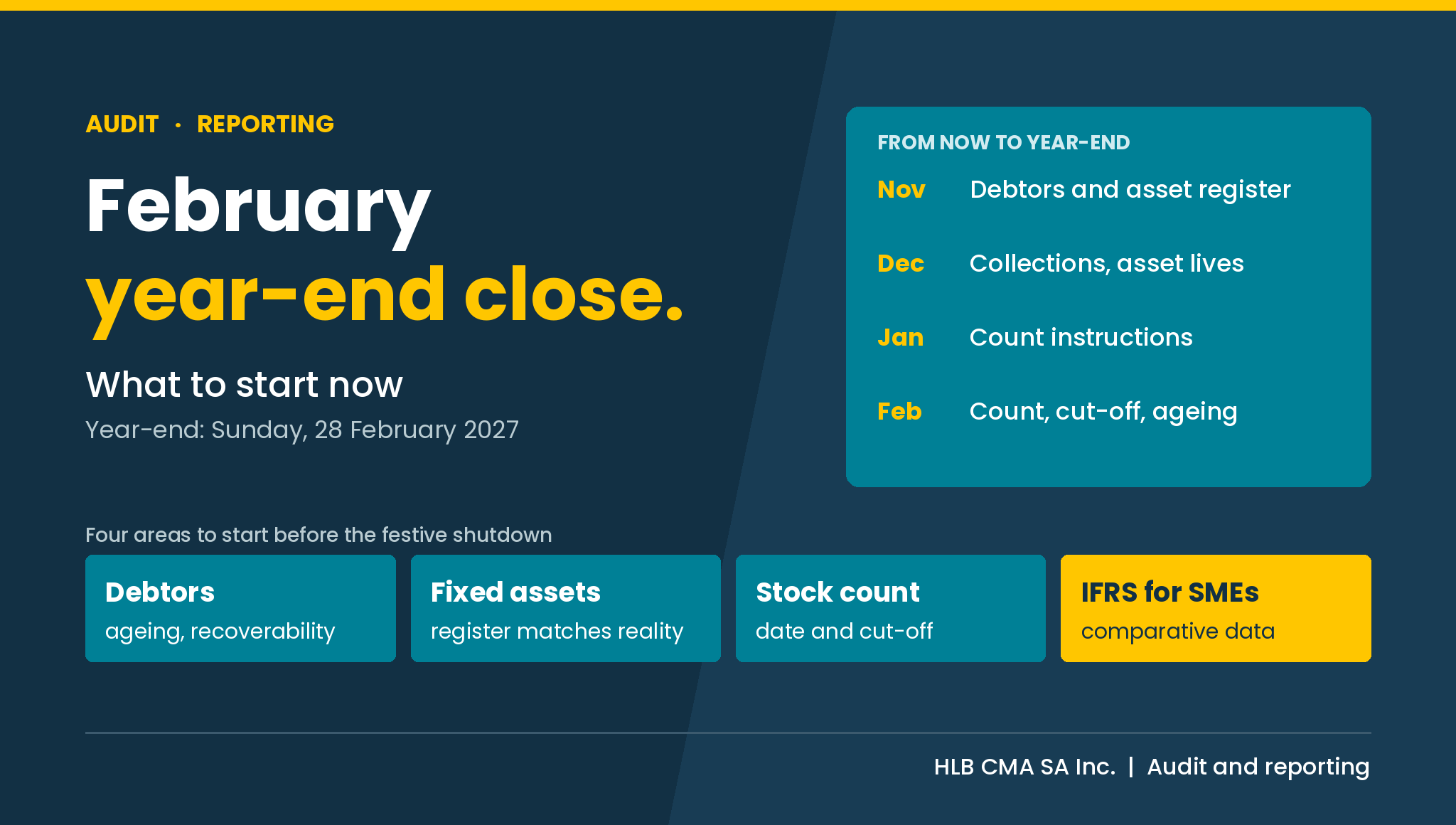
- November: start the debtors clean-up, reconcile and verify the fixed asset register, and agree the count date and the year-end timetable with your auditor or independent reviewer.
- December: follow up overdue accounts before the shutdown, and review useful lives, residual values and impairment indicators.
- January: finalise the count instructions and set up the reports you will need for the third-edition comparatives.
- February: count the stock, record cut-off, and run the age analysis and the maturity analysis at 28 February.
Our audit-ready checklist for SMMEs covers the year-end controls that sit behind these steps.
If your company must be audited, its financial statements must also name each director and prescribed officer next to their remuneration. Our article on directors’ remuneration by name explains what to gather before 28 February, including in a group.
How we can help
If we are your auditor or independent reviewer, speak to your engagement team now about the count date, the timetable and the information they will need at year-end. Our Consulting department, which is separate from our audit and assurance teams, helps companies prepare for the IFRS for SMEs third edition, including the comparative disclosures. For anything else, speak to our team.
This article provides general information only and is not a substitute for advice on your company’s specific circumstances. It refers to the IRBA’s 2025 Public Inspections Report (March 2026) and Annual Enforcement Report 2023/2024, the International Forum of Independent Audit Regulators’ 2025 Survey of Inspection Findings (April 2026), the IFRS for SMEs Accounting Standard (third edition, 2025), International Standard on Auditing 501 and section 11(j) of the Income Tax Act, as at November 2026.
debtors,february-year-end,fixed-asset-register,ifrs-for-smes,stock-count,year-end-close,