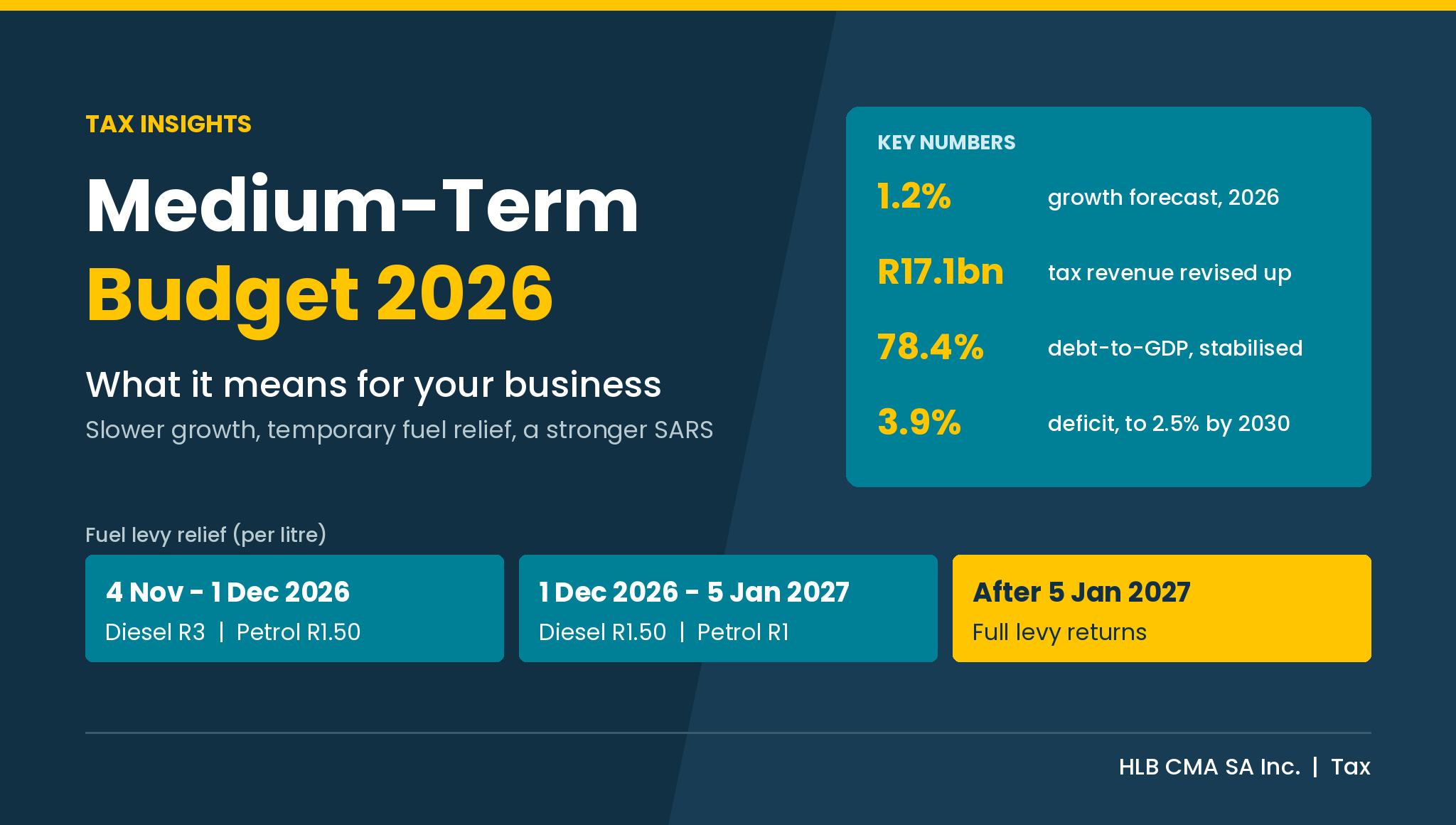
On 21 October 2026 Finance Minister Enoch Godongwana tabled the 2026 Medium-Term Budget Policy Statement (MTBPS). The mid-year “mini-budget” updates the economic outlook and the state of the public finances. Tax rate changes are normally announced in the February Budget, so the MTBPS is mainly about direction, but it still gives business owners useful signals for the year ahead.
We see three practical takeaways: plan for slower growth, treat the fuel levy relief as temporary, and expect a better-resourced SARS.
The key numbers
| Measure |
2026 MTBPS |
| Real economic growth, 2026 |
1.2%, down from 1.6% projected in February |
| Growth outlook |
1.6% in 2027 and 2% by 2029 |
| Gross tax revenue, 2026/27 |
Revised up by R17.1 billion compared with the February estimate |
| Budget deficit |
3.9% of GDP this year (February: 4.0%), narrowing to 2.5% by 2030 |
| Government debt |
Stabilised at 78.4% of GDP in 2025/26 |
| Fuel levy relief |
R3 a litre (diesel) and R1.50 a litre (petrol) from 4 November to 1 December 2026, then R1.50 (diesel) and R1 (petrol) until 5 January 2027 |
1. Plan for slower growth
Treasury now expects the economy to grow by 1.2% in 2026, well below the 1.6% it forecast in February, with growth of 1.6% in 2027 and 2% by 2029. For most businesses that means demand is unlikely to lift on its own, and customers may take longer to pay.
- Build next year’s budget on realistic sales. Start from what you are actually selling now, not from last year’s targets.
- Test the downside. Work out whether you could still pay salaries, suppliers, SARS and lenders if revenue came in 10% or 15% below budget, and for how long.
- Watch your debtors. Slower growth usually shows up first in longer payment terms. Track debtor days monthly and follow up overdue accounts early.
- Keep a rolling cash flow forecast. A 13-week forecast, updated every week, gives you time to act before a shortfall arrives. Our article on protecting business cash flow sets out five practical steps.
The Minister also noted that growth could exceed 3% a year if structural reforms stay on course, including the restructuring of Eskom and a new independent transmission operator to support a more competitive electricity market. That is an upside to monitor, not one to budget on.
2. Treat fuel relief as temporary
The fuel levy will be cut by R3 a litre for diesel and R1.50 a litre for petrol from 4 November to 1 December 2026. The relief then continues at a lower level, R1.50 a litre for diesel and R1 a litre for petrol, until 5 January 2027. Treasury puts the cost at R10 billion, funded by returning R10 billion from the Central Energy Fund to the National Revenue Fund.
For transport, logistics, agriculture and other fuel-heavy businesses, that is welcome breathing room over the festive season. But it is temporary, and the pump price also depends on oil prices and the exchange rate, so the saving at the pump may not match the levy cut.
- Don’t build the relief into prices or contracts beyond January. Quotes and fixed-price contracts that run into 2027 should assume the full levy.
- Use the saving well. Put it towards debt, working capital or a cash buffer rather than permanent cost increases.
- Track fuel separately. Recording fuel costs in their own account makes the effect of the relief, and its end, easy to see in your management accounts.
3. Expect a better-resourced SARS
Gross tax revenue for 2026/27 has been revised up by R17.1 billion, helped by higher collections from corporate income tax, dividends tax and VAT. The Minister cautioned that much of the gain comes from higher commodity prices that are expected to fade. At the same time, the adjustments include funding to modernise SARS and strengthen its ICT systems and cyber resilience, and SARS continues to tighten revenue administration and compliance.
The speech also points to customs and excise modernisation, with enhanced cargo scanning, track-and-trace capabilities and stronger frontline enforcement, and says crypto asset transactions should be assessed for legitimacy and tax compliance.
A better-funded SARS with better systems is more likely to spot late returns, mismatches and unsupported claims. Now is a good time to make sure your own house is in order:
- File and pay on time. Check that VAT, PAYE and provisional tax are up to date, and that your interim EMP501 reconciliation is submitted by 31 October 2026.
- Reconcile every month. Reconcile each VAT201 and EMP201 to your accounting records so differences are picked up early, not at year-end.
- Keep the paperwork. Make sure tax invoices, supporting documents and calculations for expense and input tax claims can be produced quickly if SARS asks.
- Declare crypto activity. If your business or its owners hold or trade crypto assets, make sure the gains and income are recorded and declared.
SARS’s wider modernisation also includes its proposed move to e-invoicing. Read our article SARS e-invoicing is coming: is your accounting system ready? for what that means for your invoicing and VAT processes.
How we can help
Our Tax & Compliance team helps businesses keep their SARS affairs up to date, from VAT and payroll taxes to provisional tax and corporate income tax returns. Our Advisory team supports budgets, forecasts and performance reporting, so you can plan for 2027 with realistic numbers.
Speak to our team about what the Medium-Term Budget means for your business.
This article is based on the 2026 Medium-Term Budget Policy Statement speech delivered on 21 October 2026. It provides general information only and is not a substitute for advice on your business’s specific circumstances.
budgeting,cash-flow,fuel-levy,medium-term-budget,mtbps,sars,tax,