For many owner-managed businesses, the audit or independent review is something that happens after year-end. The books are handed over, questions come back, and the process takes longer than anyone planned. It does not have to work that way. Most of what makes an audit or review slow and expensive can be sorted out before the year ends.
With February year-ends about four months away, now is a good time to look at your business the way your auditor or independent reviewer will. This article sets out what we focus on when we work with small, medium and micro enterprises (SMMEs), and what you can put in place now so the engagement runs smoothly and tells you something useful.
Start by confirming what you need
Not every company needs an audit. Whether yours needs an audit, an independent review or neither depends mainly on its public interest score, who prepares the financial statements, how the shares are held and what the Memorandum of Incorporation (MOI) says. A loan agreement, funding agreement or shareholders’ agreement can also require an audit even when the Companies Act does not.
Our free audit checker works this out in a few minutes. Check it again each year, because the score is recalculated at every year-end.
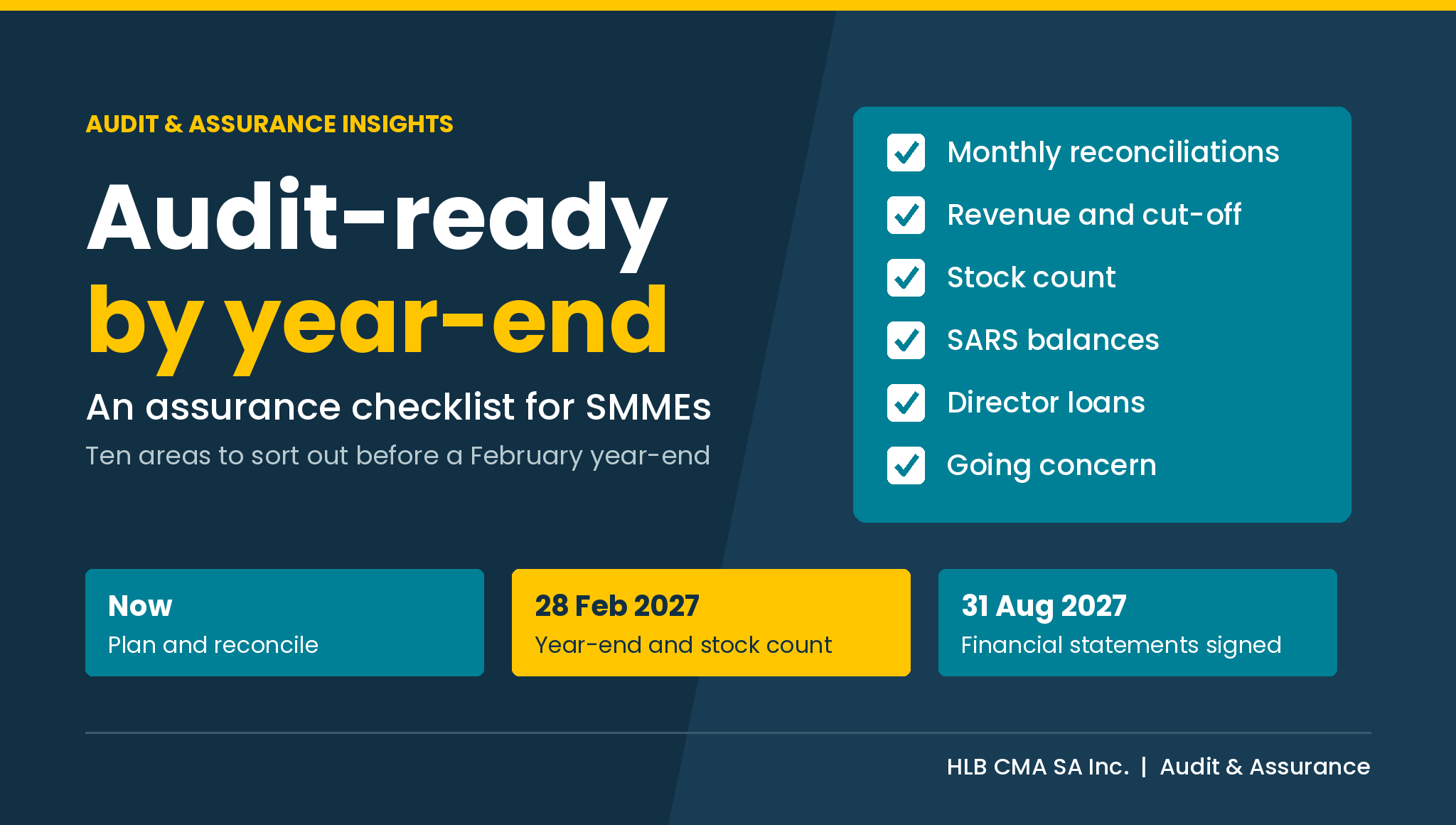
An audit gives reasonable assurance and an independent review gives limited assurance, but the preparation is much the same. The ten areas below are where SMME engagements most often slow down.
1. Books that are closed and reconciled every month
The biggest time-saver is a set of records that already balance. If bank accounts are reconciled only at year-end, every unexplained difference becomes a question during the audit.
- Reconcile every bank account, credit card and loan account monthly, and clear old reconciling items.
- Agree your debtors and creditors age analyses to the general ledger.
- Clear suspense and “sundry” accounts before year-end rather than after.
- Keep a fixed asset register that agrees to the ledger, with additions and disposals supported by invoices.
2. Revenue that is complete and in the right year
Revenue is usually the largest number in the financial statements and one of the easiest to get wrong, so it receives close attention.
- Raise invoices in the period in which the goods were delivered or the service was performed, especially around year-end.
- Keep delivery notes, job cards or timesheets that support what was invoiced.
- Record cash and card sales completely, with daily cash-ups that agree to bank deposits.
- Review credit notes issued after year-end. Large credits can mean revenue was recorded too early.
3. Inventory and the year-end stock count
If you hold stock, the count at year-end is one of the few things that cannot be redone later. When inventory is material, your auditor will normally need to attend the count, so agree the date and the process well in advance.
- Plan the count: written instructions, count teams, and pre-numbered count sheets or scanner exports.
- Stop stock movements during the count, or record them carefully, and keep the last delivery and dispatch documents before and after year-end.
- Identify slow-moving, damaged or obsolete stock. IFRS for SMEs requires inventory to be measured at the lower of cost and estimated selling price less costs to complete and sell.
- Reconcile the count to the inventory system and explain any large adjustments.
4. SARS balances that agree to your records
Tax balances are a common source of surprises. Differences between VAT returns, payroll submissions and the general ledger take time to resolve, and penalties and interest on SARS accounts often go unrecorded.
- Reconcile your VAT201 returns to the ledger for each period.
- Agree monthly EMP201 payments and the EMP501 reconciliations to the payroll and the ledger.
- Download your SARS statements of account and agree the balances, including penalties and interest, to your records.
- Keep provisional tax calculations and proof of payment together.
5. Loans to and from directors and shareholders
In an owner-managed business, the line between personal and business money is easily blurred. Loan accounts with directors, shareholders and their families attract attention for good reason.
- Record personal expenses paid by the business against the right loan account, not as business expenses.
- Put loan agreements in writing, including the interest and repayment terms.
- Before the company lends money to a director, or to a person or company related to a director, section 45 of the Companies Act requires a board decision, a special resolution of shareholders adopted within the previous two years, and the board to be satisfied that the company will still meet the solvency and liquidity test and that the terms are fair and reasonable.
- Interest-free or low-interest loans can have tax consequences, so speak to your tax adviser before you rely on them.
6. Related parties
Transactions with people and businesses connected to the owners must be identified and disclosed in the financial statements. Your auditor or reviewer will ask management to confirm that the list is complete.
- Keep an up-to-date list of the directors’ and shareholders’ other businesses and trusts, and of close family members who work in or trade with the business.
- Record sales, purchases, rentals, loans and guarantees with those parties separately, at the terms actually agreed.
7. Going concern and solvency
Financial statements are prepared on the basis that the business will keep operating. Management must assess whether that is appropriate, looking at least twelve months beyond the reporting date, and your auditor or reviewer will consider that assessment.
- Prepare a cash-flow forecast for at least the next twelve months, with the assumptions written down.
- If liabilities exceed assets, or the business depends on support from its shareholders, raise it early. Lenders and shareholders may need to subordinate their loans or confirm their support in writing.
- Monitor loan covenants and agree any waivers with the bank before year-end, not after.
8. Contracts, leases and commitments
Many adjustments and disclosures come from documents that never pass through the accounting system.
- Keep signed copies of loan agreements, leases, instalment sale agreements, guarantees and significant customer and supplier contracts in one place.
- Note any legal claims, disputes or SARS audits that are under way.
- Tell your auditor or reviewer about significant events after year-end, such as losing a major customer or taking on new debt.
9. Controls that work for a small team
Small businesses rarely have enough staff to separate every duty, and auditors understand that. What matters is that someone who is not involved in the day-to-day processing reviews the important things regularly.
- Have an owner or director review the bank statements and reconciliations every month.
- Require two people to approve electronic payments, or at least to load and release them separately.
- Verify any change to a supplier’s bank details by phoning the supplier on a number you already have, not one given in the email. Payment diversion fraud is common and hard to recover from.
- Limit access to the accounting and payroll systems, and remove access promptly when staff leave.
10. Records you can find quickly
The Companies Act requires companies to keep their records, including accounting records, for seven years. An organised digital file makes it far easier to answer sample requests during fieldwork.
- Store invoices, contracts, payroll records and board resolutions in a consistent folder structure.
- Keep minutes or written resolutions for important decisions, such as dividends, loans to directors and large purchases.
- Before a dividend is paid, the board must resolve that it has applied the solvency and liquidity test (section 46 of the Companies Act). Keep that resolution on file.
What SMME owners often do not expect
The directors are responsible for the financial statements
Your auditor or reviewer gives an opinion or conclusion on the financial statements, but the directors are responsible for preparing them and for the records behind them. The annual financial statements must be prepared within six months after year-end. The directors approve them and sign a letter confirming the information and explanations they have given.
Your auditor has to stay independent
Professional rules prevent your auditor from making management decisions or taking responsibility for your records. If you need help preparing your financial statements, our Consulting department does that work separately from our audit and review teams.
Auditors and independent reviewers have reporting duties
If an auditor finds that someone responsible for managing a company has committed an unlawful act or omission that has caused or is likely to cause material financial loss, is fraudulent or amounts to theft, or is a material breach of a fiduciary duty, the Auditing Profession Act requires the auditor to report it to the Independent Regulatory Board for Auditors (IRBA). Independent reviewers have a similar duty under the Companies Regulations to report to the Companies and Intellectual Property Commission (CIPC). Raising problems with us early gives you the chance to deal with them properly.
IFRS for SMEs is changing
The third edition of the IFRS for SMEs Accounting Standard applies to financial years beginning on or after 1 January 2027. For a February year-end, the year ending 28 February 2027 will be the comparative year, so the changes are worth understanding now. Read our article on what changes for February year-ends.
A timetable for a 28 February 2027 year-end
| When |
What to do |
| October to December 2026 |
Confirm whether you need an audit or a review, agree the engagement and timetable, and clean up loan accounts and reconciliations. |
| January to February 2027 |
Plan the stock count, reconcile your SARS accounts, and review contracts and loan covenants. |
| 28 February 2027 |
Count stock and record year-end cut-off. |
| March to May 2027 |
Close the books and prepare the annual financial statements and supporting schedules. |
| June to July 2027 |
Audit or review fieldwork, and agree any adjustments. |
| By 31 August 2027 |
The directors approve and sign the annual financial statements. |
Your company income tax return (ITR14) is due within twelve months after year-end, and the CIPC annual return is due within 30 business days after the anniversary of the company’s registration date.
More than a compliance exercise
A well-run audit or review does more than produce a signed report. Banks, funders, landlords and tender committees rely on financial statements that have been independently checked. The matters raised along the way often point to weaknesses in controls, pricing or cash management that are worth fixing in their own right, and we report them to management with practical recommendations.
Talk to us before year-end
If your company has a February year-end, the next few months are the best time to plan. Our audit and assurance team works with owner-managed businesses, growing companies and groups across South Africa.
Explore our audit and assurance services, email our team or call +27 11 315 0215.
This article provides general information only and is not legal, tax or professional advice. Speak to us about your company’s circumstances.
annual-financial-statements,assurance,audit,compliance,going-concern,independent-review,internal-controls,risk-management,smme,