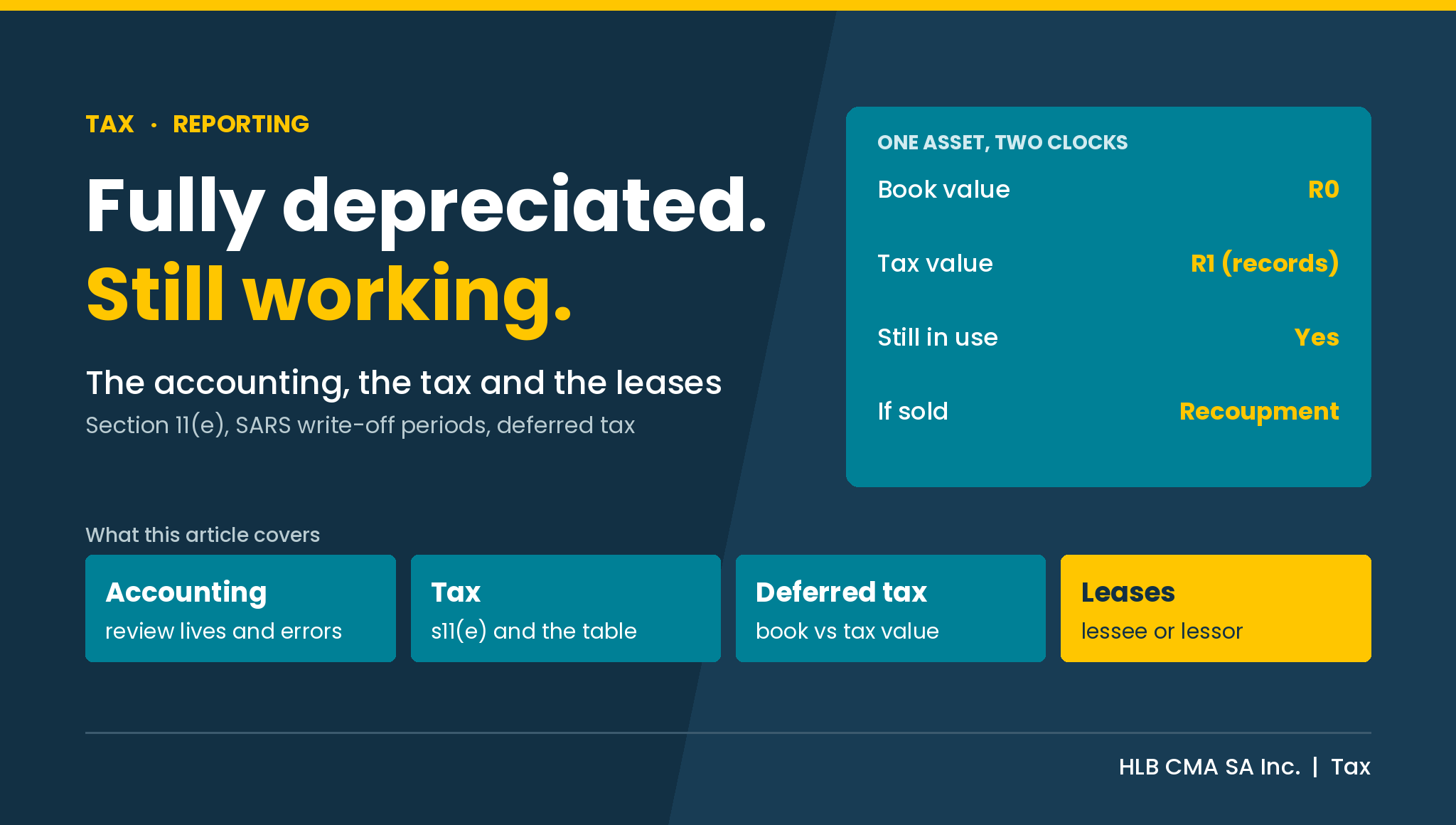
Most fixed asset registers contain assets with a book value of nil that are still in daily use: the delivery vehicle that is six years old, the server in the corner, the machine that was “fully depreciated” years ago. That is not wrong in itself, but it has consequences. It usually means useful lives were set too short or never reviewed, there are no further tax allowances on the asset, and a sale can trigger a taxable recoupment. Leases add another layer, because who may claim the allowance depends on the type of lease. This article works through the accounting, the tax and the lease rules, with worked examples.
Why assets end up fully depreciated but still in use
There are three common causes:
- Useful lives were set too short. The life used for depreciation should be the period over which the business expects to use the asset, not the shortest period anyone could defend.
- SARS’s write-off periods were used as accounting lives. SARS’s table sets acceptable periods for the tax allowance. They are not estimates of how long your assets will last in your business, and the accounting standards do not require you to use them.
- Estimates were never revisited. Once set in the asset register, useful lives and residual values are often left unchanged for the life of the asset.
The result is that profit is understated in the years the asset is depreciated and overstated afterwards, when the asset still earns income but carries no depreciation charge. It also makes the balance sheet a poor guide to what the business actually owns.
The accounting: what the standards require
Review useful lives and residual values. Under the IFRS for SMEs Accounting Standard, an entity reviews the useful life, residual value and depreciation method when there are indicators that they have changed, such as a change in how an asset is used, significant unexpected wear and tear, technological advancement or changes in market prices (paragraph 17.19). Under full IFRS, IAS 16 requires the review at least at each financial year-end. A register full of fully depreciated assets that are still working is itself an indicator that the estimates need attention.
A change in estimate is prospective. A revised useful life or residual value is a change in accounting estimate and is accounted for prospectively, from the period of the change (IFRS for SMEs paragraphs 10.15 to 10.17). Depreciation already recognised is not written back. If an asset’s carrying amount is already nil, extending its useful life does not create any further depreciation: the asset simply stays in the register at cost less accumulated depreciation until it is disposed of.
When it is an error, not an estimate. A prior period error arises from a failure to use, or a misuse of, reliable information that was available when the financial statements were authorised for issue (paragraph 10.19). If the original useful lives ignored information the business had at the time, for example its own history of replacing vehicles every eight years, the problem may be an error rather than a change in estimate. Material errors are corrected retrospectively by restating the comparatives (paragraph 10.21). This is a matter of judgement and evidence, so discuss it with your auditor or independent reviewer before year-end.
Not adjusting is non-compliance. Reviewing and, where necessary, adjusting useful lives and residual values is a requirement of the accounting framework, not an optional refinement. If the estimates are not reviewed and adjusted as the IFRS for SMEs Standard or IFRS requires, the financial statements do not comply with that framework. Where the effect is material, the auditor will issue a modified opinion: a qualified opinion or, if the effect is pervasive, an adverse opinion (ISA 705 (Revised)). An independent reviewer will likewise issue a modified conclusion under ISRE 2400 (Revised). A modified report can have consequences well beyond the financial statements, for example with lenders, in tenders and in credit applications.
Depreciation stops, the asset stays. Depreciation continues while an asset is idle or retired from active use, unless it is fully depreciated, and it stops when the asset is derecognised (paragraph 17.20). An asset is derecognised when it is disposed of or when no future economic benefits are expected from it (paragraph 17.27). Assets that have been scrapped, sold or lost should therefore be removed from the register, while fully depreciated assets that are still in use stay in it.
Residual values matter too. If the residual value of an asset rises to an amount equal to or greater than its carrying amount, the depreciation charge is nil until the residual value falls below the carrying amount again (IAS 16, paragraph 54). Vehicles that hold their resale value are the usual example.
Disclosure. A change in estimate must be disclosed, with its effect on the current period and, where practicable, on future periods (paragraph 10.18). IAS 16 encourages entities to disclose the gross carrying amount of fully depreciated property, plant and equipment that is still in use (paragraph 79(b)). The IFRS for SMEs Standard does not require this, but it is useful information for lenders and owners.
Revaluation is not a quick fix. The IFRS for SMEs Standard allows the revaluation model for a whole class of property, plant and equipment (paragraph 17.15). Switching to it is a change in accounting policy, applies to every asset in the class, needs regular valuations and creates deferred tax on the revaluation surplus. It is a policy decision for the long term, not a way to put a single fully depreciated asset back on the balance sheet.
The tax: wear and tear under section 11(e)
For tax purposes, depreciation in the accounts is ignored. Instead, section 11(e) of the Income Tax Act allows a wear-and-tear allowance on machinery, plant, implements, utensils and articles used in the taxpayer’s trade. SARS’s Interpretation Note 47 (Issue 5) sets out how the allowance works:
- The asset must be owned by the taxpayer, or acquired as purchaser under an instalment credit agreement, and used for trade. Buildings and other structures of a permanent nature do not qualify.
- An asset held in reserve or as a replacement in case of a breakdown is not regarded as “used”, so it does not qualify until it is brought into use.
- The allowance is based on cost: the cash cost excluding finance charges and any VAT the taxpayer can claim as input tax. Revaluations are ignored.
- The allowance may be calculated on the straight-line or the diminishing-value method, and is apportioned when an asset is used for trade for only part of the year.
- Assets that qualify for certain other capital allowances, such as plant under section 12C or the manufacturing plant of a small business corporation under section 12E(1), are dealt with under those sections instead.
The write-off table
The “write-off schedule” most people refer to is the annexure to Interpretation Note 47 and Binding General Ruling 7 (Issue 4), both dated 9 February 2021. It lists the write-off periods, on the straight-line method, that SARS accepts for assets brought into use on or after 24 March 2020. Some common examples:
| Asset |
Years |
| Personal computers |
3 |
| Mainframes and servers |
5 |
| Computer tablets and similar devices |
2 |
| Software for personal computers |
2 |
| Cellular telephones |
2 |
| Office equipment: electronic / mechanical |
3 / 5 |
| Photocopying equipment |
5 |
| Furniture and fittings |
6 |
| Passenger cars |
5 |
| Delivery vehicles |
4 |
| Trucks: heavy duty / other |
3 / 4 |
| Trailers |
5 |
| Fork-lift trucks |
4 |
| Power tools (hand-operated) |
5 |
| Solar energy units |
5 |
Three points about the table are often missed:
- Shorter periods need SARS’s agreement. A taxpayer who wants to use a shorter period than the table must fully motivate it, for example because of the operating environment or the intensity of use, and submit the motivation to SARS before filing the return in which the allowance is claimed.
- Assets not in the table are written off over their expected useful life.
- Second-hand assets are written off over their expected remaining useful life, taking their condition into account.
Small items. An item costing less than R7 000 may be written off in full in the year it is acquired and brought into use, as long as it functions on its own and is not part of a set. Items that form a set cannot be split to fall under the threshold, and the rule does not apply to lessors who let the assets.
Faster allowances. New plant and machinery used directly in a process of manufacture can qualify under section 12C for 40% of cost in the first year and 20% in each of the next three years. A small business corporation may deduct the full cost of manufacturing plant in the year it is brought into use, and may elect a 50%, 30% and 20% write-off over three years for other qualifying assets under section 12E. These assets reach a tax value of nil much faster than their book value.
When an asset is fully written off for tax
Once the full cost has been claimed, no further allowance is available, however long the asset stays in use. SARS requires assets written off in full to stay in the records at a residual value of R1 until they are disposed of, not merely until they are fully written off. The records must be kept for five years from the date the relevant return is submitted, because they are needed to calculate the recoupment and any capital gain when the asset is eventually sold.
Selling the asset. When an asset is sold for more than its tax value, the allowances previously claimed are recouped and included in income under section 8(4)(a), limited to the allowances claimed. For a fully written-off asset, the whole selling price up to the original cost is therefore taxable at the company rate of 27%. Any amount above the original cost is a capital gain, of which 80% is included in a company’s taxable income, an effective rate of 21.6%.
Scrapping the asset. Section 11(o) allows a deduction for the loss when a depreciable asset is scrapped, sold, lost or destroyed for less than its tax value, provided its expected useful life for tax purposes did not exceed ten years when it was acquired and the taxpayer elects to claim it (SARS Interpretation Note 60). A fully written-off asset has no tax value left, so scrapping it gives no further deduction.
VAT. If your company is a VAT vendor, the sale of a business asset is generally subject to VAT at 15%, regardless of its book or tax value. Different rules can apply to motor cars on which input tax could not be claimed, so check those sales separately.
Deferred tax: two clocks for the same asset
Because book depreciation and tax allowances run on different clocks, the carrying amount of an asset and its tax base are rarely the same. The difference is a temporary difference that gives rise to deferred tax under Section 29 of the IFRS for SMEs Standard (IAS 12 under full IFRS). Three examples, at a tax rate of 27%:
| Asset and cost |
Book depreciation |
Tax write-off |
Values at the end of the period |
Deferred tax |
| Delivery vehicle, R600 000 |
4 years |
4 years (table) |
After year 4: book nil, tax nil |
None |
| Office furniture, R120 000 |
5 years |
6 years (table) |
After year 5: book nil, tax R20 000 |
Asset of R5 400, if recoverable |
| Manufacturing machine, R1 000 000 |
10 years |
4 years (section 12C: 40/20/20/20) |
After year 4: book R600 000, tax nil |
Liability of R162 000 |
In the furniture example, the remaining R20 000 is claimed for tax in year 6 and the deferred tax asset reverses. In the machine example, the book depreciation of R100 000 a year in years 5 to 10 is not deductible, and the deferred tax liability reverses by R27 000 a year. If useful lives are extended, the deferred tax balances change with them, so the deferred tax calculation should be updated whenever the asset register is.
Worked example: the delivery vehicle, five years on
A company with a February year-end bought a delivery vehicle for R600 000, excluding VAT, on 1 March 2021. It depreciated the vehicle over four years with no residual value, and claimed the allowance over the four years in SARS’s table. By 28 February 2025 the vehicle had a book value of nil and a tax value of nil, recorded at R1. In the year ending 28 February 2027, management expects to use it for another three years and then sell it for about R150 000.
- Accounting: the revised estimate is a change in estimate. No depreciation is written back and no further depreciation arises, because the carrying amount is already nil. If the four-year life ignored information the company had in 2021, the company should consider whether this is a prior period error instead.
- Tax: no further wear-and-tear allowance is available. When the vehicle is sold for R150 000, the full amount is recouped and taxed at 27%, which is R40 500 of tax. The accounting profit on sale is also R150 000, so there is no deferred tax difference.
- VAT: if the company is a VAT vendor, VAT is generally charged on the selling price.
How leases change the picture
The wear-and-tear allowance belongs to the owner of an asset, or to the purchaser under an instalment credit agreement. Whether you can claim it on a leased asset therefore depends on the type of lease, and the accounting often follows different rules from the tax.
1. Assets you lease under an ordinary lease
A lessee under an ordinary lease does not own the asset and cannot claim the section 11(e) allowance. The rentals are deductible as they are incurred instead. Under the IFRS for SMEs Standard, operating lease payments are expensed on a straight-line basis over the lease term (paragraph 20.15), so the accounting and the tax are usually close.
Under IFRS 16, which applies to companies reporting under full IFRS, the lessee recognises a right-of-use asset and a lease liability, and charges depreciation and interest. SARS does not follow this: in the tax computation, the right-of-use depreciation and the interest are added back and the lease payments are deducted. The difference between the right-of-use asset and the lease liability on the one hand, and their tax bases of nil on the other, gives rise to deferred tax. If a lease is extended after the right-of-use asset has been fully depreciated, the lease liability is remeasured and the right-of-use asset is adjusted, so it can come back onto the balance sheet.
2. Instalment credit agreements and finance leases
The Income Tax Act treats the purchaser under an instalment credit agreement as entitled to the wear-and-tear allowance, even though ownership may only pass at the end. The seller who keeps ownership cannot claim it. A lease qualifies as an instalment credit agreement under the definition in the VAT Act if, among other things:
- the rentals include stipulated finance charges;
- the total payable by the lessee, plus any stipulated residual value, exceeds the cash value of the asset;
- the lessee is entitled to use the asset for at least 12 months; and
- the lessee bears the risk of loss or destruction and the maintenance and repair obligations, or the other risk-sharing arrangement set out in the definition applies.
Where the agreement qualifies, the lessee claims the allowance on the cash cost of the asset, excluding the finance charges, using the write-off table as for an owned asset. In the accounts, an asset held under a finance lease is depreciated over the shorter of the lease term and its useful life if it is not reasonably certain that ownership will pass (paragraph 20.12). An asset can therefore be fully depreciated at the end of a lease and still be used for years if the company keeps it, which is a reason to review its useful life before the lease ends.
If a lessee under an ordinary lease later buys the asset, section 8(5) can require some of the rentals it deducted to be included in income as a recoupment. Check this before agreeing to buy a leased asset at the end of the lease.
3. Assets you lease out
A lessor who owns the asset claims the allowance, but with three adjustments:
- the allowance is based on cost less any residual value agreed in the lease;
- an asset let for longer than the period in SARS’s table is written off over the lease period;
- the R7 000 small-item write-off does not apply to assets acquired for letting.
Section 23A can limit the allowances on certain leased assets to the lessor’s rental income from them, and section 23G can deny allowances in certain sale-and-leaseback arrangements. Once a leased asset has been written off for tax, the rentals it continues to earn are fully taxable, with no allowance to set against them.
4. Improvements to leased premises
Improvements that a lessee makes to premises it rents, such as partitioning, air-conditioning or a new shopfront, raise their own questions.
- Accounting: legal limits on the use of an asset, such as the expiry date of the related lease, are one of the factors in setting its useful life (paragraph 17.21(d)). If the lease is renewed, the useful life of the improvements should be reviewed: improvements that were fully depreciated over the original lease term may still have years of use left.
- Tax, improvements required by the lease: if the lease obliges the lessee to make the improvements, section 11(g) allows the cost to be deducted over the remaining period of the lease, from the date the improvements are completed, limited to 25 years and to the amount stipulated in the lease or, if no amount is stipulated, the fair and reasonable value of the improvements. If the lease ends early, the unclaimed balance is deductible in that year (SARS Interpretation Note 110, Issue 2). The landlord, in turn, includes the value of the improvements in its gross income.
- Tax, voluntary improvements: improvements the lease does not require do not qualify under section 11(g). Depending on the asset, another allowance may apply. Where the landlord is national, provincial or local government, or an exempt entity, or the improvements are made under a public-private partnership or the Independent Power Producer Procurement Programme, section 12N deems the lessee to be the owner of the improvements for certain allowances, such as section 12C and section 13quin (SARS Interpretation Note 119, Issue 2).
What to do before year-end
- Run a report of assets with a nil book value that are still in use, and their total original cost.
- Review useful lives and residual values by asset class, starting with the classes that have the most fully depreciated assets.
- Decide, with evidence, whether any adjustment is a change in estimate or a prior period error, and update the depreciation policy for new additions.
- Keep a separate tax register: tax values, the write-off period used for each asset, and fully written-off assets at R1 until disposal.
- Remove assets that have been sold, scrapped or lost from both registers.
- Update the deferred tax calculation for any change in useful lives.
- List your leases and decide which are instalment credit agreements, which are ordinary leases, and which improvements were required by the lease.
- Before selling an old asset, work out the recoupment and the VAT, and check that insurance values reflect what the assets would cost to replace, not their book value.
Our article on the February year-end close covers the fixed asset register reconciliation and the other areas to start now.
How we can help
Our tax team can review your tax asset register, the write-off periods you use, your lease agreements and the tax on planned disposals. If we are your auditor or independent reviewer, speak to your engagement team early about any change to useful lives. Our Consulting department, which is separate from our audit and assurance teams, can update depreciation policies and deferred tax calculations for companies that need help with their financial statements. For anything else, speak to our team.
This article provides general information only and is not tax or accounting advice. It refers to sections 8(4)(a), 8(5), 11(e), 11(g), 11(o), 12C, 12E, 12N, 23A and 23G of the Income Tax Act, SARS Interpretation Notes 47 (Issue 5), 60 (Issue 2), 110 (Issue 2) and 119 (Issue 2), Binding General Ruling 7 (Issue 4), the definition of an instalment credit agreement in the Value-Added Tax Act, the IFRS for SMEs Accounting Standard (third edition, 2025), IAS 16, ISA 705 (Revised) and ISRE 2400 (Revised), as at November 2026. Speak to a tax adviser about your specific circumstances.
deferred-tax,depreciation,fixed-assets,leases,recoupment,section-11e,wear-and-tear,