For most South African businesses, a tax invoice is a PDF attached to an email. Under SARS’s proposals, that will not be enough for much longer.
In August 2026 SARS published its VAT Modernisation Consultation Paper. It sets out a Digital VAT Model built on structured e-invoices and near real-time reporting of VAT data to SARS. The public comment period ran until 16 October 2026. South Africa is following a path many tax authorities have already taken: Italy, Mexico, Kenya and Egypt already require e-invoicing in some form.
Nothing changes overnight. The roadmap runs to 2030 and beyond, and many details are still open. But the proposals reach into how you issue invoices, how you process supplier invoices and how your VAT return is prepared. That groundwork takes time, and businesses that start early will find the move cheaper and get more out of it.
What SARS is proposing
The Digital VAT Model has three parts.
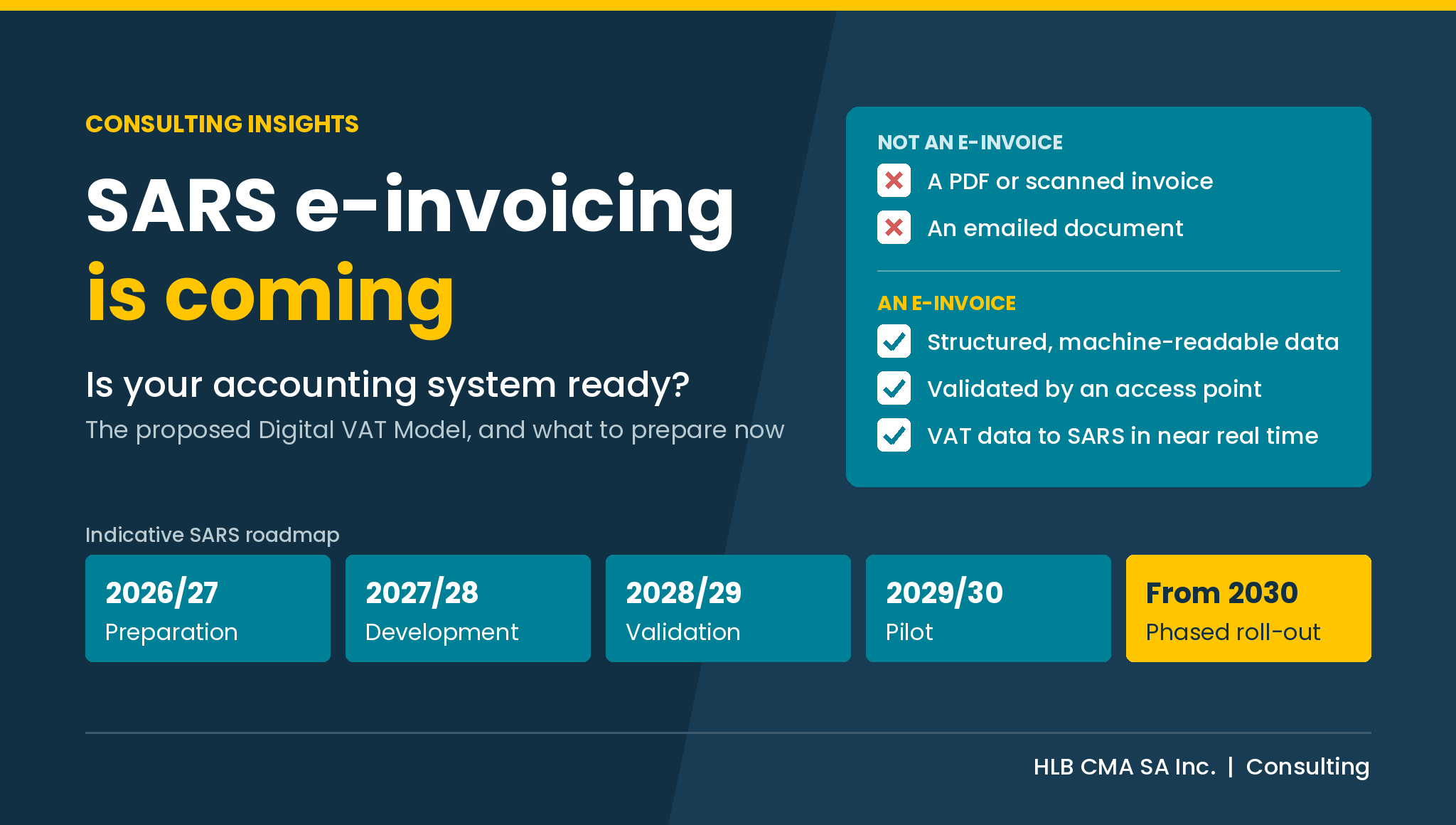
- E-invoicing. A tax invoice is issued as structured, machine-readable data in a prescribed format, so the buyer’s system can read it without anyone retyping it. The consultation paper is clear that an e-invoice is not a PDF, a scanned image or an emailed document.
- An interoperability framework. Invoices travel between businesses through accredited service providers, called access points, which validate each invoice before it is delivered. SARS describes a five-corner model: the supplier, the supplier’s access point, the buyer’s access point, the buyer, and SARS, which receives the VAT data through its own access point.
- E-reporting. VAT transaction data reaches SARS in near real time, not only when the VAT return is filed. Over time SARS intends to use that data to pre-fill VAT returns, which vendors would confirm or edit, and eventually to move towards automatic assessment of VAT.
The paper mentions international standards such as EN 16931, the UN/CEFACT Cross-Industry Invoice and Peppol PINT BIS as examples, but SARS has not chosen a standard yet. The technical requirements will be set out in regulations.
A change most businesses have not noticed: the buyer’s response
Under the proposed model, the buyer confirms receipt of each e-invoice and indicates how it treats the VAT, for example whether the input tax is claimed in full, in part or not at all. Today most businesses make those decisions at month-end, when the VAT return is prepared. Under the new model they would move much closer to the day the invoice arrives. For many finance teams, that is the biggest practical change in the paper.
The proposed timeline
| Phase |
Indicative timing |
What happens |
| 1. Preparation |
2026/27, about 12 months |
Research, readiness assessment and publication of draft VAT regulations. |
| 2. Solution development |
2027/28, about 12 months |
Standards, specifications and operating models. The VAT regulations are finalised. |
| 3. Validation |
2028/29, about 6 months |
Testing in a controlled environment with voluntary participants. |
| 4. Pilot |
2029/30, about 6 months |
A live pilot with voluntary participants from priority segments. |
| 5. Phased implementation |
From 2030, about 36 months |
Large businesses first, with government required to receive e-invoices for procurement. Micro, small and medium enterprises follow over several years, and sales to consumers come last. |
SARS describes this roadmap as indicative. Turnover thresholds and mandatory dates have not been set, and large taxpayers are expected to adopt e-invoicing voluntarily before it becomes compulsory.
Who should start preparing now
- Large businesses. They are first in line. Changes to an ERP system take time to budget, build and test, and voluntary participation in testing and the pilot is planned for 2028 to 2030.
- Businesses that sell to government. Government entities will have to receive e-invoices for procurement, and SARS may prioritise this alongside large businesses.
- Suppliers to large companies. As big customers move to e-invoicing, they are likely to favour suppliers whose invoices flow straight into their systems.
- Smaller businesses. Micro, small and medium enterprises come later, and SARS says it will consider service-provider portals, simplified tools and low-cost software options. Even so, a business that still invoices from Word or Excel has the furthest to go.
Seven things worth doing now
SARS has not published technical specifications, so this is not the time to buy a system built for e-invoicing. It is the time to fix the foundations any e-invoicing system will depend on. Most of these steps pay for themselves anyway, through cleaner books and a faster month-end and year-end.
1. Invoice from your accounting system, not a template
Invoices typed in Word or Excel cannot reliably be turned into structured data. Move all invoicing, including credit notes and debit notes, into your accounting system or a billing system that feeds it. Count how many places in the business issue invoices, such as branches, point-of-sale systems and project billing, and plan to bring them together.
2. Clean up customer and supplier details
Structured invoices are checked automatically, so the details on them have to be right. Confirm the registered names, VAT numbers and addresses of your main customers and suppliers, and remove duplicate accounts from your debtors and creditors ledgers.
3. Get VAT codes right on every line
Every product and service should carry the correct VAT treatment: standard-rated, zero-rated or exempt. Review the tax codes in your item lists and chart of accounts, and retire catch-all codes that staff use when they are not sure.
4. Decide the input tax treatment when the invoice arrives
If buyers must report whether input tax is claimed in full, in part or not at all, that decision belongs in supplier invoice processing, not at month-end. Write a short, practical policy: which expenses do not qualify for input tax, such as entertainment and most passenger vehicles, and how costs used for both taxable and exempt activities are apportioned.
5. Reconcile VAT every month
Once SARS sees transactions as they happen and pre-fills returns, differences between your ledger, your VAT201 and your suppliers’ invoices will show up sooner. Reconcile each VAT201 to the ledger, and follow up on missing or incorrect supplier invoices every month rather than at year-end.
6. Ask your software provider about its plans
Ask whether your accounting or ERP system will connect to accredited access points, what that will cost, whether your version will still be supported and whether any customisations will need to change. If your system is old or heavily customised, build that into your upgrade plans for 2027 to 2029.
7. Map your invoice-to-VAT-return process
Write down who raises invoices, who approves supplier invoices, where VAT decisions are made and how the VAT201 is prepared. The map shows where the manual steps and spreadsheets sit, and where automation will help most.
More than a compliance exercise
E-invoicing is usually discussed as a compliance cost, but it is also a chance to fix how finance data flows through the business. Structured invoices can go straight into the buyer’s accounting system without retyping, which reduces errors, speeds up approvals and makes supplier reconciliations simpler. SARS expects the model to make VAT compliance simpler and more predictable for vendors and to reduce their administrative effort.
The same clean, structured data supports everything downstream: more reliable management accounts, a faster month-end close and annual financial statements that can be prepared and signed sooner.
How our Consulting department can help
Our Consulting department helps businesses get their accounting data and processes ready, well before e-invoicing becomes compulsory:
- a readiness review of your invoicing, accounts payable and VAT processes;
- clean-up of customer and supplier data, VAT codes and the chart of accounts;
- working with your software provider on system and upgrade plans;
- monthly reconciliations and a faster, more automated month-end and year-end.
For VAT technical questions we work alongside our Tax & Compliance team, and our Advisory team supports wider finance-function and systems projects. Compilation engagements are performed by our Consulting department, which is separate from our audit and assurance teams.
Explore our Consulting services or email our Consulting team.
This article is based on SARS’s VAT Modernisation Consultation Paper of August 2026. The proposals may change as SARS finalises the model and publishes regulations. It provides general information only and is not a substitute for advice on your business’s specific circumstances.
accounting-systems,advisory,consulting,digital-vat-model,e-invoicing,finance-automation,sars,vat,vat-modernisation,